Nontuberculous mycobacteria (NTM) infections have continued to increase in recent years and have become an important global public health problem. Because different NTM species and subspecies differ significantly in pathogenicity, drug-resistance profiles, and treatment regimens, rapid and accurate species identification is of great importance for guiding precision anti-infective therapy. However, traditional detection methods generally face challenges such as cross-reactivity interference, insufficient multiplexing capacity, and difficulty resolving mixed infections, limiting the precise diagnosis and individualized treatment of mycobacterial infections.
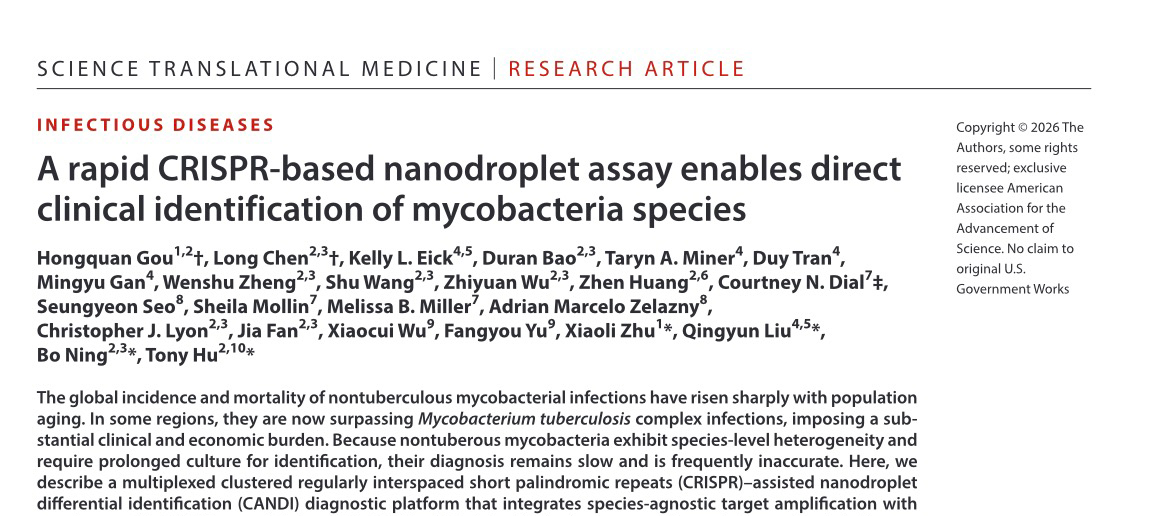
On September 16, 2026, Professor Ye Hu’s team at the School of Biomedical Engineering, Tsinghua University, together with domestic and international collaborators, published a cover article in Science Translational Medicine entitled “A rapid CRISPR-based nanodroplet assay enables direct clinical identification of mycobacteria species.” They developed a rapid multiplex pathogen identification platform based on CRISPR-assisted nanodroplet pairing, named CRISPR-Assisted Nanodroplet Pairing for Differential Identification of Nontuberculous Mycobacteria (CANDI). The platform innovatively integrates precise molecular recognition by CRISPR/Cas12a with fluorescence-encoded nanodroplet technology. Through universal amplification combined with species-specific recognition, it achieves
simultaneous detection of multiple mycobacterial species and subspecies, effectively overcoming key bottlenecks in traditional molecular diagnostics, such as limited multiplexing capacity, cross-interference, and culture dependence. CANDI can achieve highly specific identification of 15 clinically relevant mycobacteria and can identify complex mixed-infection samples.
Technology Introduction
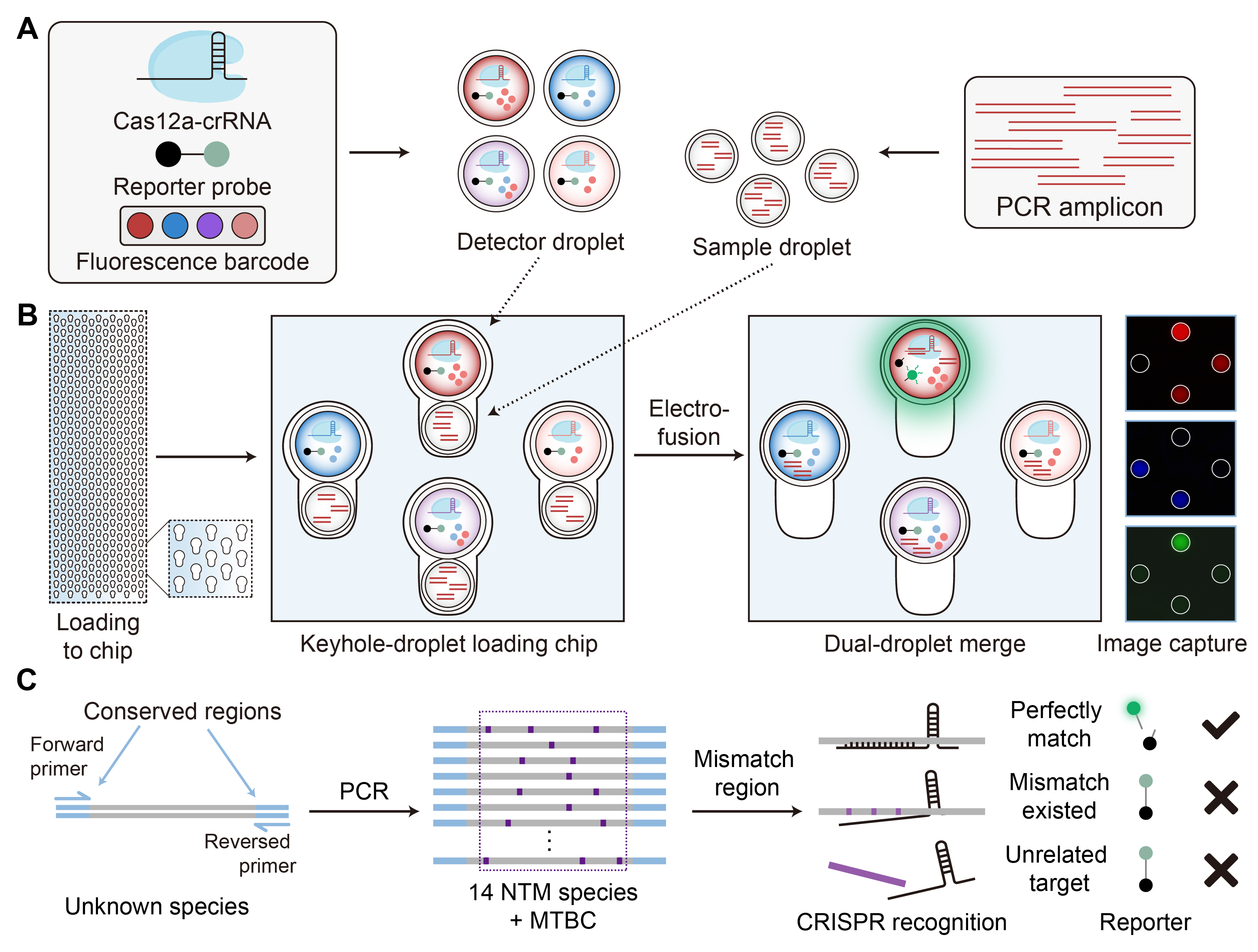
Figure 1. CRISPR-assisted nanodroplet pairing technology enables precise identification of nontuberculous mycobacteria.
This study followed a technical roadmap of “bioinformatics design, platform construction, and multicenter clinical validation” to develop a rapid multiplex pathogen identification platform based on CRISPR and nanodroplets
(CANDI). Based on sequence analysis of mycobacterial 16S and 23S rRNA, the research team screened highly conserved regions to design universal amplification primers. Using a self-developed bioinformatics pipeline, they developed species/subspecies-specific CRISPR/Cas12a guide RNAs (gRNAs), constructing a molecular recognition system covering 15 clinically relevant mycobacteria. Subsequently, different detection systems were encapsulated in fluorescence-encoded nanodroplets. Digital microfluidics enabled precise pairing and fusion of detection droplets and sample droplets. Combined with Cas12a signal activation and fluorescence barcode decoding, this enabled simultaneous detection of multiple targets.
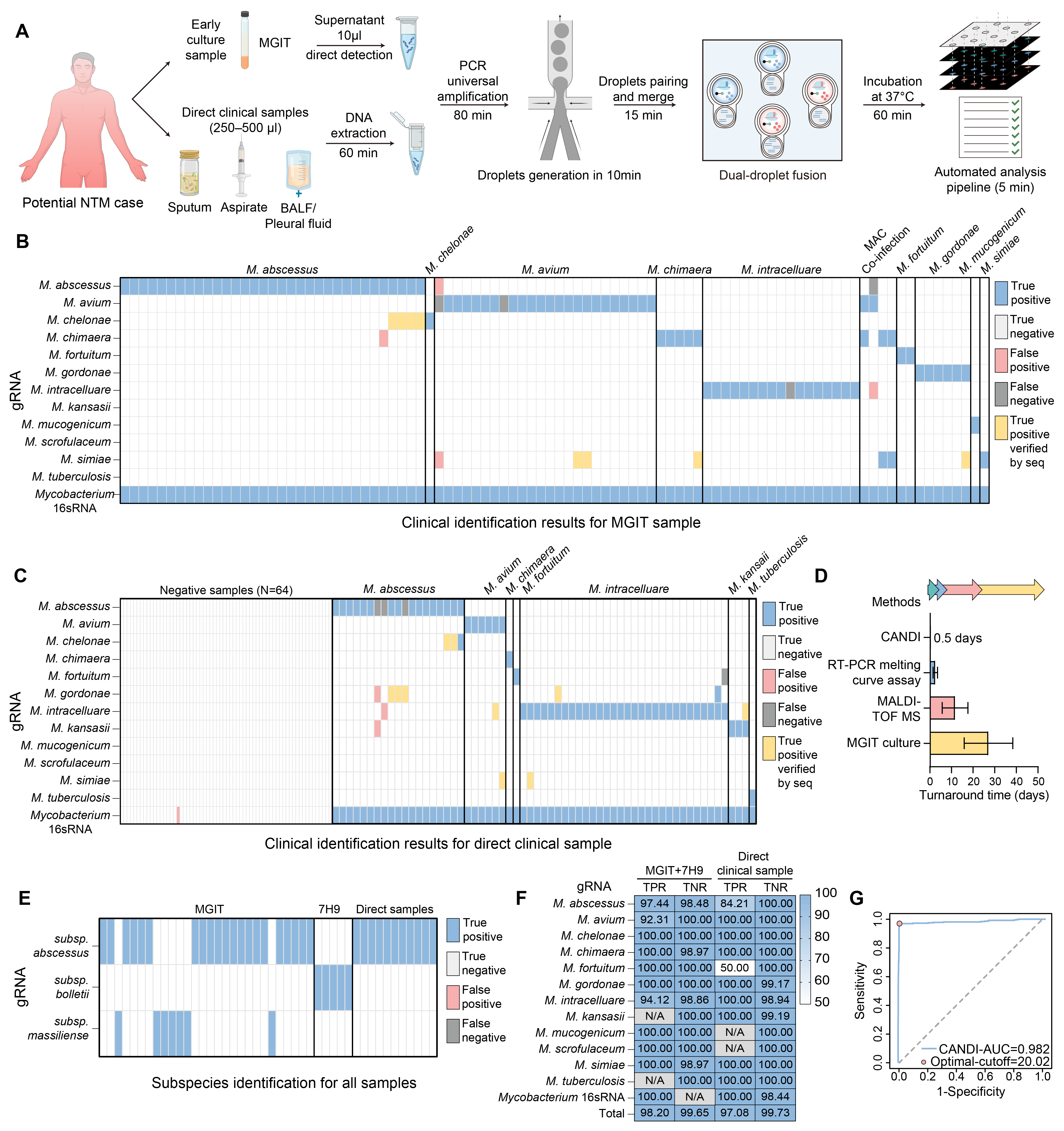
Figure 2. Performance of CANDI in the detection of multiple nontuberculous mycobacteria.
After the platform was established, its sensitivity, specificity, and stability were systematically evaluated using standard strains, genomic DNA, and simulated clinical samples. With support from collaborative platforms including the U.S. National Institutes of Health (NIH), the University of North Carolina (UNC), and Professor Fangyou Yu’s team at Shanghai Pulmonary Hospital Affiliated to Tongji University, 230 clinical samples were collected for validation. CANDI does not rely on traditional cultureand can directly test clinical respiratory samples such as sputum and tracheal aspirates. It completes species- and subspecies-level identification within 3.5 hours, achieving 97.3% sensitivity and 99.7% specificity, providing a new technical approach for rapid and precise diagnosis of infectious diseases and personalized anti-infective therapy.
Summary and Outlook
This study developed CANDI, a multiplex pathogen identification platform based on CRISPR-assisted nanodroplet technology. It enables rapid, highly specific detection of 15 clinically relevant mycobacterial species and subspecies and can be directly applied to clinical samples such as sputum and bronchial aspirates. By combining universal target amplification with CRISPR/Cas12a-specific recognition, CANDI addresses key problems in traditional mycobacterial detection, including cross-reactivity, culture dependence, and long turnaround times, and achieves species- and subspecies-level identification within 3.5 hours. The platform’s core advantage lies in its precise gRNA design strategy. The research team analyzed sequence conservation across 103,332 mycobacterial genomes, selected target regions with low intraspecies variation and high interspecies divergence, and optimized candidate gRNA sequences using a self-developed bioinformatics pipeline, thereby ensuring orthogonal recognition among different species. For the highly similar sequence differences among subspecies of the Mycobacterium abscessus complex, mismatches were further artificially introduced to enhance Cas12a recognition, enabling subspecies-level discrimination.
In clinical validation, CANDI not only accurately identified common mycobacteria but also detected slow-growing mycobacteria and mixed-infection samples missed by traditional culture and identification workflows, providing an important basis for the precise diagnosis and treatment of complex NTM infections. Previously, the team developed LIT-TB, a CRISPR-based point-of-care testing (POCT) device for rapid tuberculosis detection (Sci Transl Med 2025, 17, 793). This study further leveraged CRISPR recognition and fluorescence-encoded nanodroplet technology to achieve rapid identification of mycobacterial species and subspecies, providing a new technical approach for precise clinical diagnosis of infections.
Professor Ye Hu of Tsinghua University, Professor Bo Ning of Tulane University, Professor Qingyun Liu of the University of North Carolina at Chapel Hill, and Professor Xiaoli Zhu of Shanghai Tenth People’s Hospital Affiliated to Tongji University are the co-corresponding authors of the paper. Hongquan Gou, a doctoral student at Shanghai Tenth People’s Hospital Affiliated to Tongji University, and Dr. Long Chen of Tulane University are the co-first authors. This work was also supported by Shanghai Pulmonary Hospital Affiliated to Tongji University, Tulane University, the University of North Carolina at Chapel Hill, the National Institutes of Health, and other institutions.
Original article link:
https://www.science.org/doi/10.1126/scitranslmed.aef2648