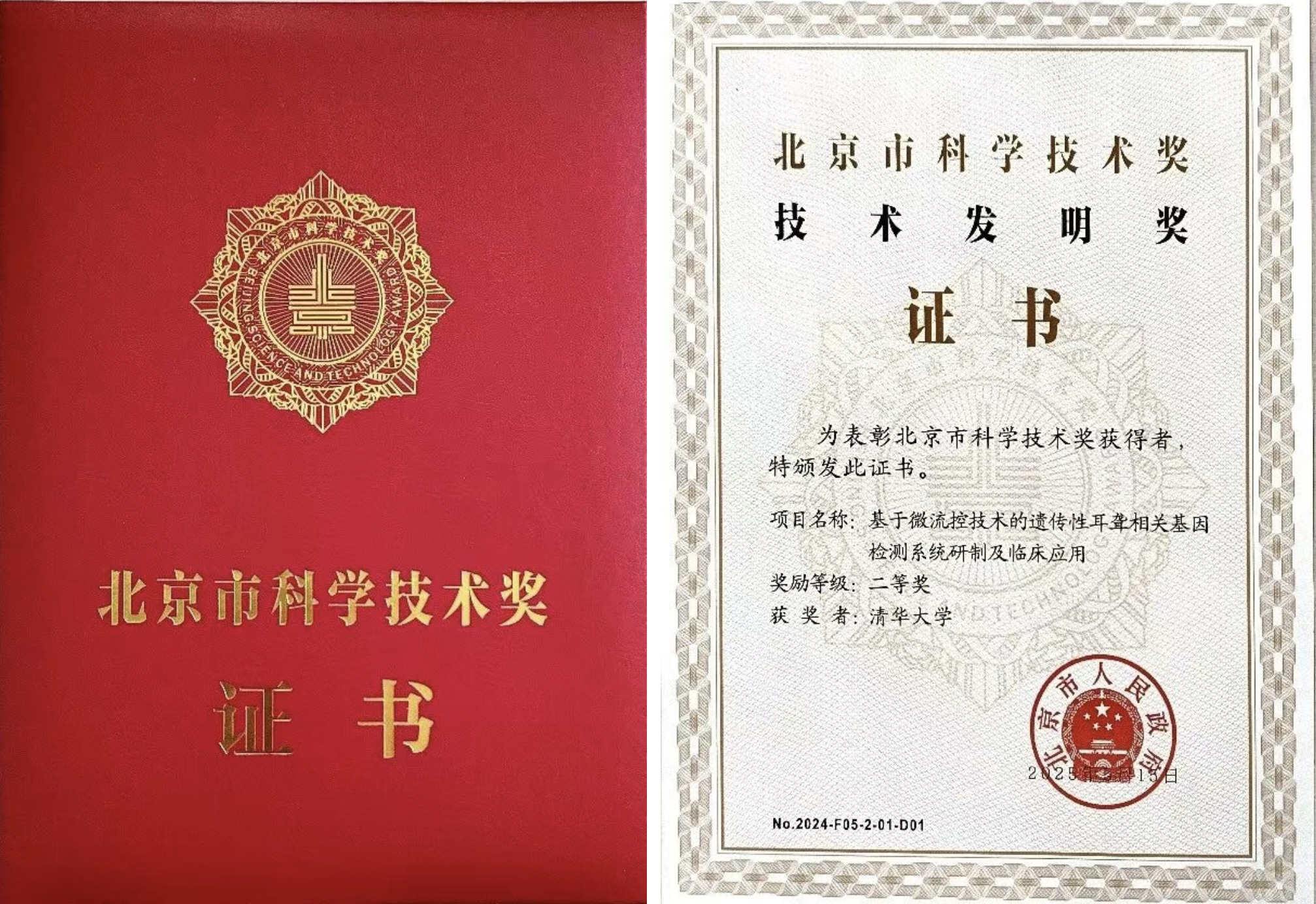
Recently, the Beijing Municipal People's Government held the 2024 Beijing Municipal Science and Technology Award Conference. As a leading unit, Tsinghua University won 9 first prizes and 11 second prizes, with 3 faculty members receiving the Outstanding Young Talent Award of Zhongguancun. The project "Development and Clinical Application of a Microfluidic System for Hereditary Deafness-related Genes Detection" led by Xu Youchun from the School of Biomedical Engineering (BME) was honored with the Second Prize of Technological Invention.
Project Highlights
The project pioneered a microfluidic multiplex analysis technology based on centrifugal distribution and thermal sealing blocking, inventing a microfluidic multiplex nucleic acid detection chip. By dividing multiplex PCR reaction into many individual reactions, it solved the challenge of multiplex nucleic acid detection in a fully sealed system. For the first time, it integrated microfluidic technology with competitive allele-specific PCR to achieve rapid genotyping of hereditary deafness-related genes, developing a chip-based kit for fast and accurate detection of hot-spot mutations of hereditary deafness. Additionally, the supporting instrument and software were developed to enable high-throughput and convenient testing of clinical samples. As a microfluidic detection product with the highest mutation coverage compared to the existing relative products, it has been approved as the Class III medical device by National Medical Products Administration of China and possesses multiple technical advantages to facilitate clinical applications.
About Xu Youchun
Xu Youchun is an Associate Researcher whose research focuses on the development of microfluidic fully integrated in vitro diagnostic (IVD) technology and microfluidic multiplex nucleic acid analysis technology. He has received honors such as the Beijing Science and Technology New Star and the Translational Medicine Innovation Award. Focusing on technological innovation and application in the interdisciplinary field of "microfluidics-based IVD", he has developed a series of novel fluid manipulation techniques for centrifugal microfluidic platforms, laying a foundation for the development of clinically applicable microfluidic detection products. His microfluidic multiplex analysis chip provides a platform for rapid and accurate detection of hereditary deafness-related mutations, while his fully integrated microfluidic IVD technologies (e.g., respiratory virus detection chips) enable on-site and rapid testing of infectious diseases. His ongoing research on microfluidic single-cell/single-particle/single-molecule analysis technology aims to provide high-throughput tools for basic research.
About the Award
The Beijing Municipal Science and Technology Award is a provincial-level science and technology award established by the Beijing Municipal People's Government. It attracts participation from top domestic and foreign universities, leading enterprises, research institutes, and medical institutions across various fields, recognized as an authoritative honor in the science and technology community. It aims to reward individuals and organizations that have made outstanding contributions to scientific and technological progress and economic and social development through innovative technological achievements and their promotion. This honor not only affirms the project's academic and application value but also showcases the strong scientific research and innovation capabilities of the participating units.