On October 18, 2024, the "Tsinghua University (School of Biomedical Engineering) - Sanbo Brain Hospital Brain-Computer Precision Medicine Joint Center Establishment Ceremony and Frontier Forum" was grandly held at the Tsinghua University Medical Science Building. The establishment of this joint center aims to focus on brain-computer precision medicine technology innovation and clinical transformation, promote cutting-edge research in brain disease big data modeling and computing, precision diagnosis and treatment new technologies, and build China's leading research platform for brain disease precision diagnosis and treatment and brain health technology innovation.
At the establishment ceremony, Professor Hong Bo, Director of the Joint Center and from Tsinghua University's School of Biomedical Engineering, and Professor Luan Guoming, Deputy Director of the Center and Co-founder of Sanbo Brain Hospital, delivered speeches respectively. Professor Liu Peng, Secretary of the Party Committee of Tsinghua University's School of Biomedical Engineering, and Mr. Zhang Yang, Chairman of Sanbo Brain Group, jointly unveiled the Joint Center. The establishment of the center marks the official launch of in-depth cooperation between the two sides in the fields of scientific and technological innovation and achievement transformation in the brain disease sector.
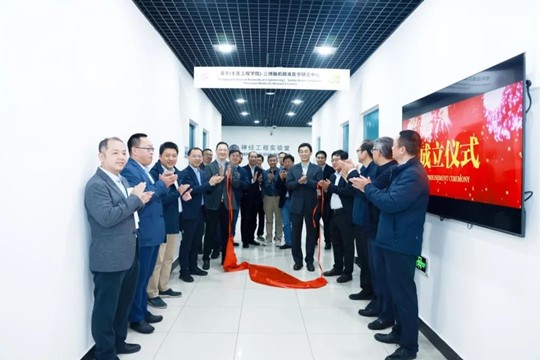
Pictured: Establishment Ceremony of Tsinghua University (School of Biomedical Engineering) - Sanbo Brain Hospital Brain-Computer Precision Medicine Joint Center
In the afternoon of the same day, the Brain-Computer Precision Medicine Frontier Forum was held as scheduled. Professor Wang Guangzhi, Executive Dean of the School of Biomedical Engineering, and Mr. Zhang Yang, Chairman of Sanbo Brain Group, delivered speeches respectively, expressing the good will of both sides to deepen medical-engineering cooperation and promote the transformation of innovative achievements. Several professors from Tsinghua University's School of Biomedical Engineering in the fields of neural engineering and medical imaging, and clinical experts from Sanbo Brain Hospital shared cutting-edge technologies and challenges in brain-computer precision medicine, and conducted in-depth discussions on the difficult problems in clinical diagnosis and treatment of brain diseases.
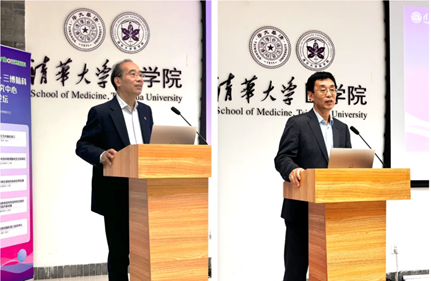
Pictured: Professor Wang Guangzhi (left) and Mr. Zhang Yang (right) delivering speeches at the Brain-Computer Precision Medicine Frontier Forum
Professor Luan Guoming introduced the development of China's neuromodulation field over the past 20 years, particularly the exploration and innovation journey of the Sanbo Brain neurosurgical team in epilepsy diagnosis and treatment. He compared the application advantages and diagnostic effectiveness of different neural imaging techniques in clinical epilepsy treatment, emphasizing the importance of invasive EEG recordings such as SEEG in studying human brain function, anatomy and disease mechanisms. In addition, Professor Luan summarized the progress and clinical efficacy of various neuromodulation technologies in recent years, expressing the hope to further combine clinical experience with new engineering technologies to promote the innovation and development of precision neuromodulation therapy.
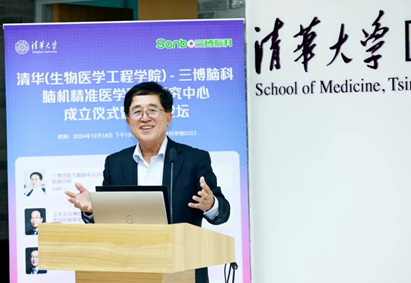
Professor Luan Guoming's Presentation
Professor Gao Xiaorong vividly reviewed the century-old history of the brain-computer interface field and envisioned the broad prospects for future development. With the vigorous development of technology, brain-computer interfaces are moving forward in the direction of low trauma and high efficiency. Based on this, Professor Gao introduced the team's long-term important contributions in SSVEP, new neural decoding paradigms, non-invasive signal acquisition technology based on skull electrical modification, and other aspects.
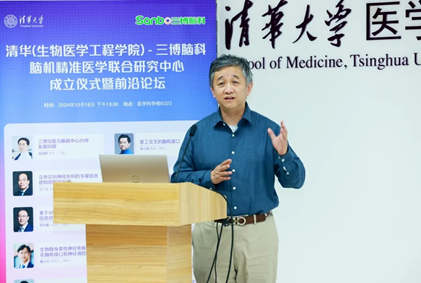
Professor Gao Xiaorong's Presentation
Professor Wang Guangzhi introduced the importance of medical devices in precision medicine, elaborating on the development of neurosurgical operation auxiliary medical devices from the aspects of "visibility," "accuracy," and "low trauma." He emphasized the importance of developing medical devices and software from an engineer's perspective with clinical needs as the guidance, continuously improving them to ultimately serve real clinical problems, and achieving the typical win-win cooperation of medical-engineering integration.
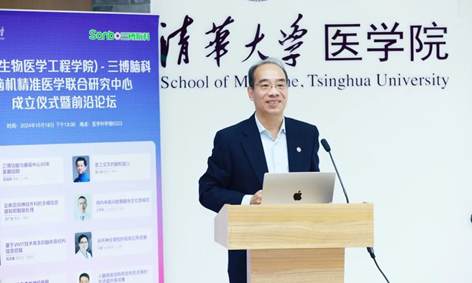
Professor Wang Guangzhi's Presentation
Director Wang Mengyang introduced the research progress at home and abroad on the epileptogenic zone inference from interictal intracranial EEG in epilepsy. He pointed out the necessity of further analyzing the large amount of effective information in interictal epilepsy data, but noted that different theoretical models in existing research still need a large number of clinical verifications, which poses challenges for the application of interictal epilepsy data in auxiliary diagnosis.
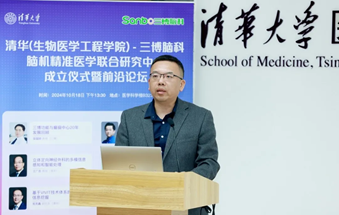
Director Wang Mengyang's Presentation
Researcher Yuan Kexin introduced his team's independently developed new tissue clearing method and cross-scale structure analysis system (VIVIT technology), which can make fresh biopsy brain specimens transparent without deformation. Combined with various imaging technologies, it can obtain cross-scale, super-resolution three-dimensional structural information of tissues. This technical system lays the foundation for the mining of organic lesion-related tissue structure information and helps in the development of precise diagnosis and treatment technologies for diseases.

Researcher Yuan Kexin's Presentation
Director Wang Xiongfei introduced the necessity and urgency of using neuromodulation technology for drug-resistant epilepsy. Vagus nerve stimulation is the most representative, low-degree-of-freedom, but most widely used method in neuromodulation. The previous open-loop stimulation had limited efficiency, and with the development of recent closed-loop technology based on heart rate variability, its clinical practicality has become excellent. Director Wang also demonstrated the interactive interface of closed-loop stimulation hardware, providing patients with a new, more effective, and more energy-efficient neuromodulation method, and looking forward to the broad clinical application prospects of closed-loop neuromodulation technology in the future, benefiting the majority of drug-resistant epilepsy patients.
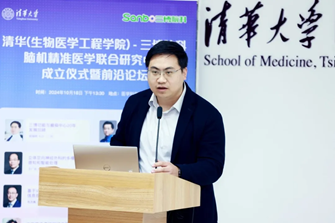
Director Wang Xiongfei's Presentation
Researcher Dai Xiaochuan gave a presentation on the application of bio-invisible flexible neural electrodes in brain-computer interfaces and neuromodulation. He introduced the development and research results of tissue-like scaffold bioelectronic sensors, building a brain-machine fusion interface in vivo to achieve a zero-rejection, lifelong stable, high-resolution, high-throughput brain-computer interface system.
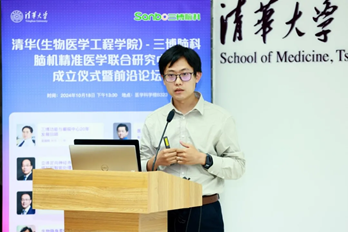
Researcher Dai Xiaochuan's Presentation
Researcher Tian Qiyuan introduced the use of advanced hardware systems, modeling methods, and artificial intelligence-based image computing technology to achieve rapid and precise in vivo characterization of the human brain's microstructure and structural connections. He promoted the wider application of the developed more efficient and practical diffusion magnetic resonance imaging methods in brain science research and clinical diagnosis and treatment of brain diseases, providing more powerful support for clinical decision-making and establishing an effective paradigm for artificial intelligence-enabled brain science and brain disease research.
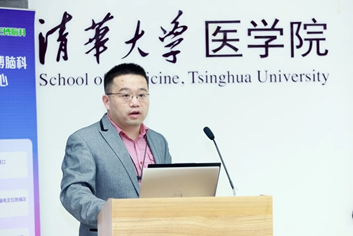
Researcher Tian Qiyuan's Presentation
Dr. Yang Yujiao reviewed the research history of neural plasticity mechanisms at home and abroad and introduced the team's latest research progress on neural plasticity changes and compensation mechanisms after cerebral hemisphere surgery. Based on long-term tracking experimental results of brain functional networks and behavior, she indicated that EEG physiological indicators are reliable biomarkers for neural remodeling and functional recovery, which will help guide the formulation of clinical treatment strategies and evaluate rehabilitation effects in the future.
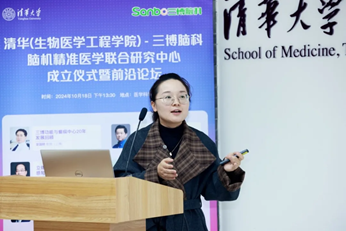
Dr. Yang Yujiao's Presentation
Finally, Professor Hong Bo gave a summary speech and released the latest evaluation results on the safety and effectiveness of two clinical trial patients with the minimally invasive brain-computer interface NEO. He looked forward to the technological innovation and clinical application prospects of the new generation of minimally invasive brain-computer interfaces.
On the same day, the first management committee meeting of the joint center was successfully held. The meeting deliberated and adopted the center's annual work plan, budget, and research project funding plan. Over the next three years, the joint center will support researchers from the School of Biomedical Engineering and clinicians from Sanbo Brain Hospital to carry out cooperation through a 1+1 medical-engineering interdisciplinary model. Starting from clinical needs and problems, it will use emerging technologies such as brain-computer interfaces, artificial intelligence, and big data to empower the clinical diagnosis and treatment of brain diseases, benefit more patients, and make greater contributions to Healthy China.
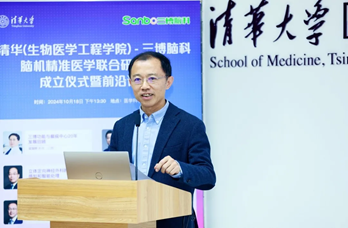
Professor Hong Bo's Summary Speech