Extracellular Vesicles (EVs) are nanoscale vesicles released by cells, widely present in various body fluids such as blood, urine, and cerebrospinal fluid. Carrying RNA, DNA, and protein information from their source cells, they serve as crucial "molecular messengers" reflecting disease states. However, traditional EV analysis typically relies on ultracentrifugation or multi-step purification processes, which are not only time-consuming and operationally complex but also prone to sample loss, limiting clinical and large-scale applications.
Recently, a team led by Professor Hu Ye from the School of Biomedical Engineering, Tsinghua University, in collaboration with Professor Ning Bo from Tulane University, USA, investigated an innovative detection method for liquid biopsy: the Liposome-EV Fusion + CRISPR molecular diagnostic system. This method involves directly delivering nucleic acid amplification and CRISPR detection reagents into the interior of EVs, enabling highly sensitive, isolation-free detection of low-abundance molecular markers in body fluids. It provides a new technological pathway for the early diagnosis of infectious diseases, tumors, and neurological disorders. The related research findings, titled "Direct delivery of assay reagents to extracellular vesicles in liquid biopsies for biomarker analysis," were published in the journal 《Nature Protocols》 on January 30, 2026.
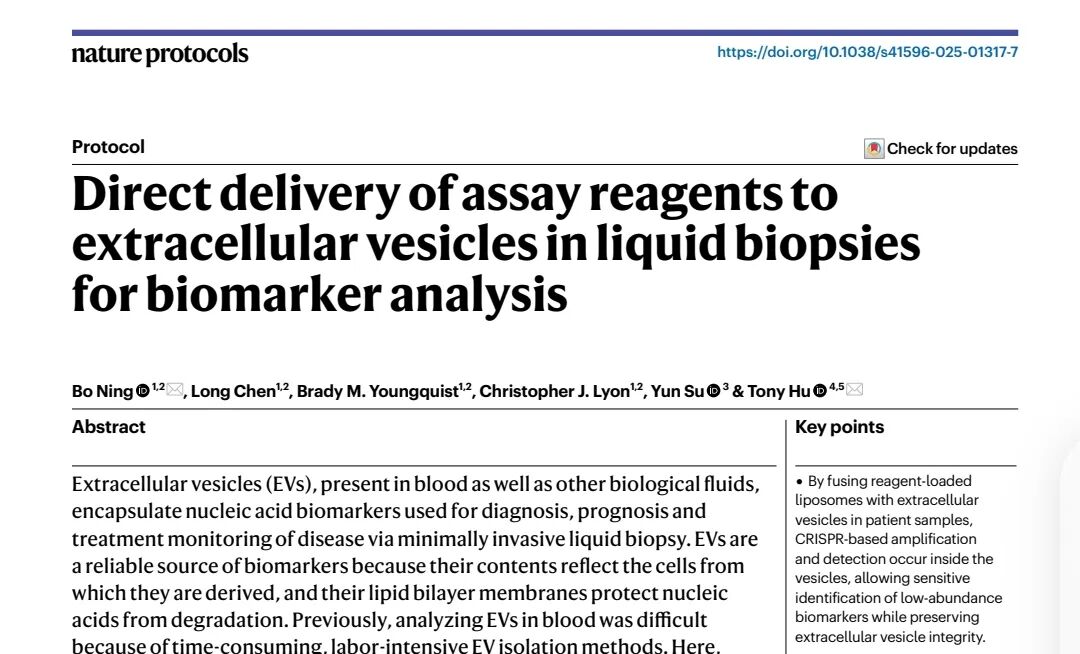
Click for more information on the paper
Highlights of the Innovative Method
The research is structured into four key stages: Liposome construction, EV antibody capture, Liposome-EV fusion, and CRISPR signal output. The specific solutions are as follows:
Delivering the Detection System "Into" Extracellular Vesicles: Utilizing engineered liposomes to encapsulate nucleic acid amplification and CRISPR detection reagents, which enter the EVs post-fusion to perform in situ reactions.
Eliminating Complex Separation Steps: Capturing EVs directly via antibodies for detection, reducing errors and loss associated with sample processing.
High Sensitivity and Strong Versatility: By simply changing primers and gRNA, the method can be extended from detecting viral RNA to various markers, including tumor miRNA and mutated DNA.
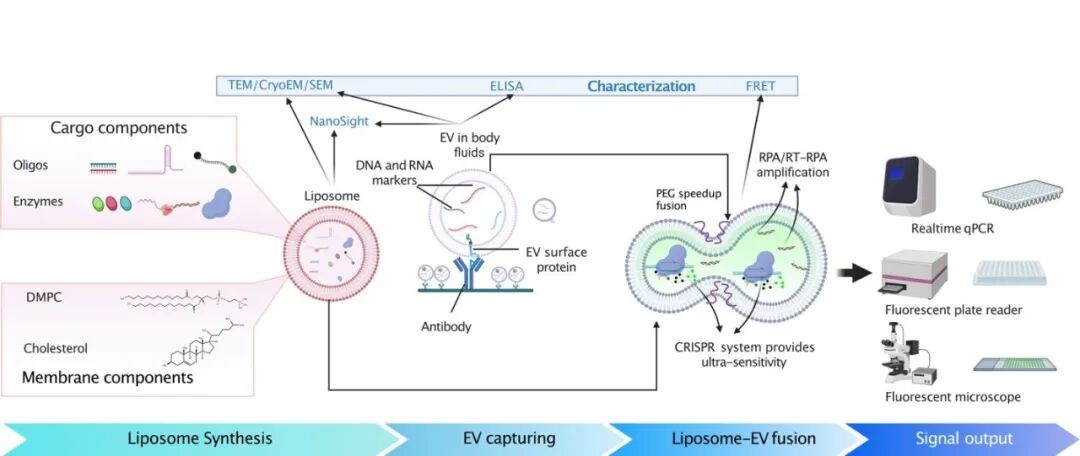
Schematic diagram of the overall workflow
Method Procedure Breakdown
Capturing EVs: Antibodies are immobilized on the surface of a detection plate to selectively "capture" EVs from the sample.
Fusion and Delivery: Liposomes loaded with the detection system and PEG (to promote fusion) are added, causing the liposomes to fuse with the EV membranes.
Signal Amplification: Isothermal amplification and CRISPR recognition reactions occur inside the EVs, generating detectable fluorescent signals.
Readout: Quantitative analysis is performed using a microplate reader, real-time PCR, or fluorescence imaging system.
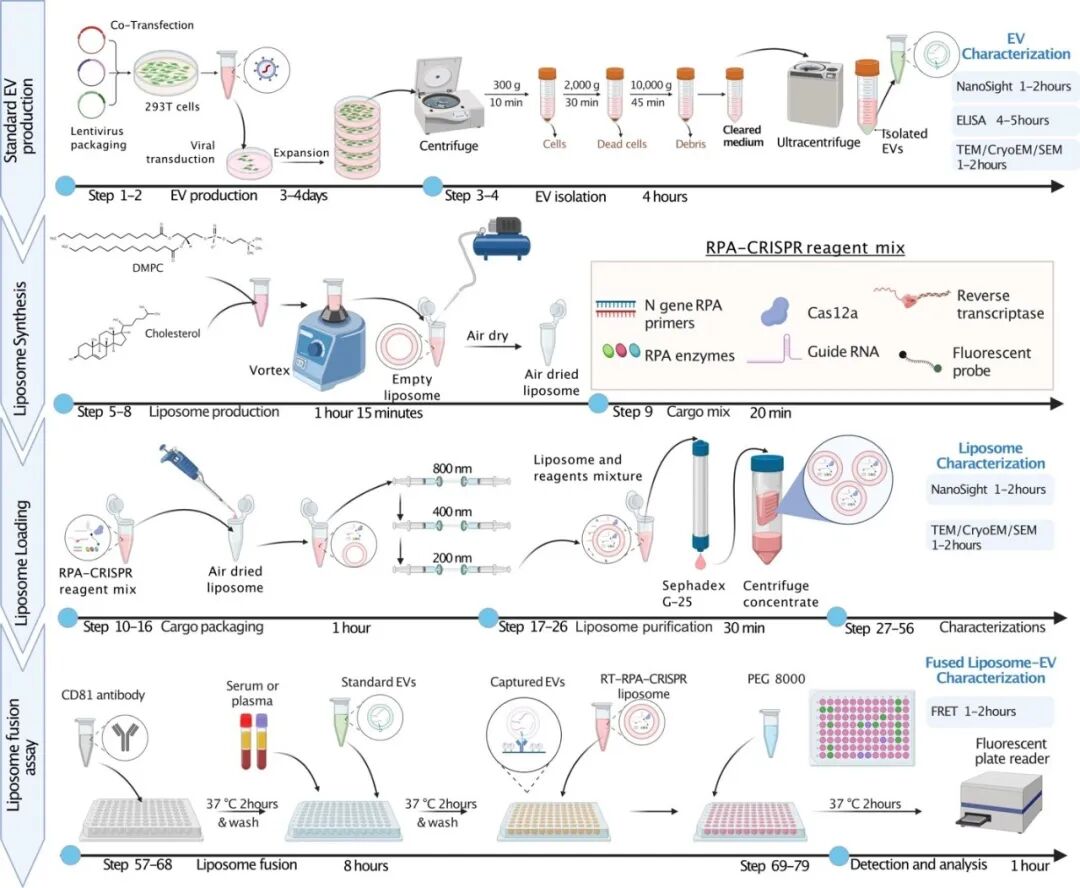
Illustration of method steps
Application Prospects
Medical Diagnosis: Viral infection detection, tumor marker analysis, treatment response monitoring.
Basic Research: Elucidating EV heterogeneity, deciphering intercellular communication mechanisms.
Translational Medicine: Development of portable detection platforms and establishment of standardized clinical workflows.
Engineering and Materials Science: Investigating liposome and biological membrane fusion mechanisms.
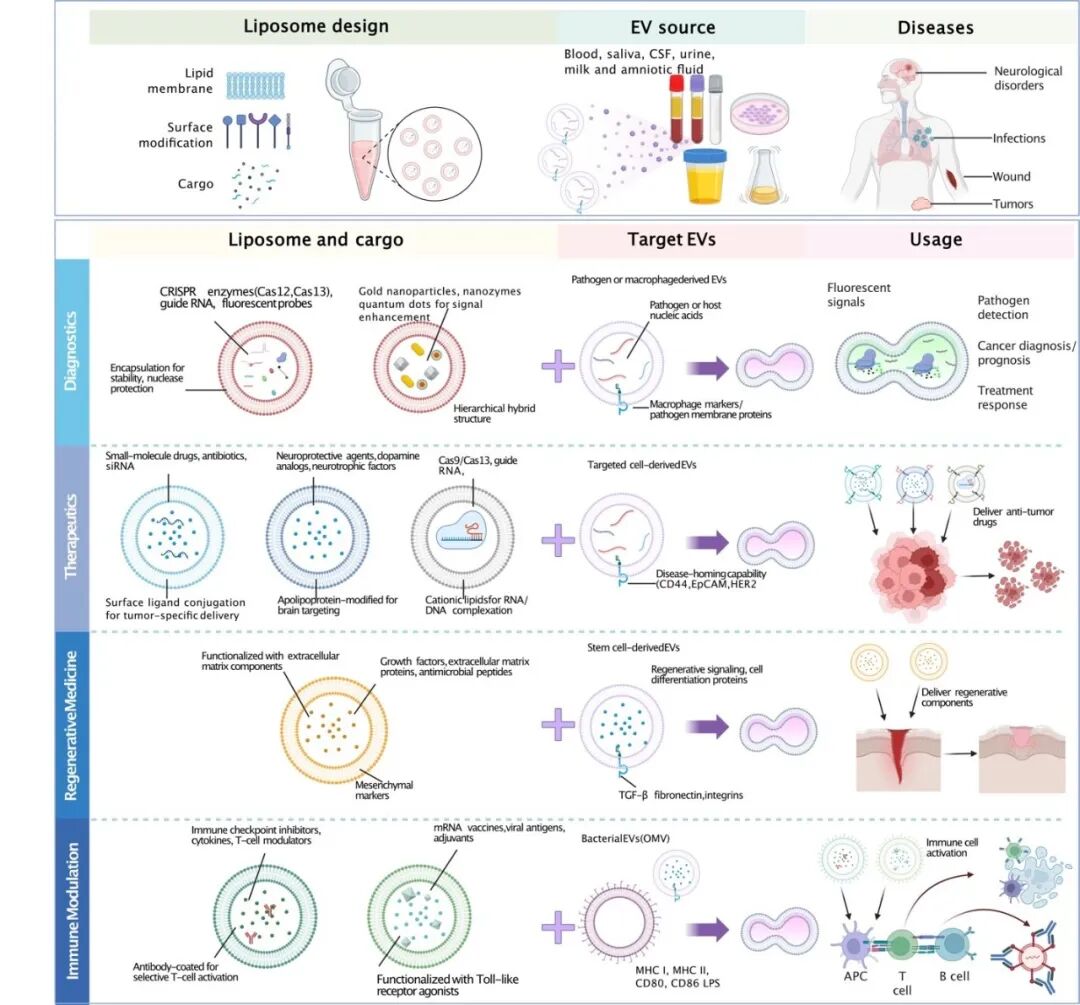
Examples of multidisciplinary application scenarios
This achievement demonstrates the continuous innovative capability of Professor Hu Tony Ye's team at the intersection of biomedical engineering, molecular diagnostics, and nanotechnology. It also provides an exemplary pathway for building technological platforms that bridge "basic research to clinical translation." This system possesses both standardization potential and engineering scalability, holding significant importance for advancing scientific research to serve public health and precision medicine.